
Cabell Wanted Listings
Cabell County does not appear to publish its own most-wanted page. There is no verified sheriff's warrant list. No local fugitive gallery. No sign of a regular feature with photos or rewards. That gap matters. Anyone hunting for a Cabell roster should not treat a stray search result as one.
The best official starting point is the West Virginia State Police Most Wanted hub. It covers the whole state. That means it won't filter down to Cabell names. From there you can reach State Police cold cases, parole absconders through the Division of Corrections, U.S. Marshals notices, Eastern Panhandle listings, and the FBI's national list. Each agency posts and updates its own entries. So check the date and issuing office on the original notice before trusting anything.
One caution about custody. Cabell County uses the Western Regional Jail, a regional WVDCR facility. A person sitting in that jail is not necessarily a Cabell arrest. A jail listing is not a wanted list either. The arresting agency, the county field, and the court record tell you what a booking means. For current custody, turn to the official Cabell booking and roster paths instead of an informal fugitive search.
A statewide or partner notice works best as a public-safety tool, not a personal lookup. Read the agency name, the notice date, the court or jurisdiction, and the listed contact route. Notices can omit fields. A missing name proves nothing about court process. That official absence is exactly why a real county check runs through the court and custodian sequence covered below.
- Open the official State Police hub and select only the linked agency resource that matches the notice being reviewed.
- Read the agency, date, location, case details, and contact information on the original publication. Do not rely on a reposted image or partial text.
- For a Cabell-related question, identify the issuing court or agency before using the Magistrate or circuit search routes.
- If information is useful to public safety, report it through the original agency’s official contact channel and do not make personal contact.
These steps help you read a public notice without leaping to conclusions. They cannot confirm anyone's status. That power rests elsewhere. If a name looks familiar but the full identifiers don't match, stop there. Ask a clerk, a lawyer, or the agency itself before going further.
Cabell Wanted Listing Fields
No verified Cabell publication sets a standard format for these listings. So the table below makes no promises. It cannot guarantee that every field appears on a given notice. What it does is simple. It lays out what to look for on an original, official notice, and it explains why the issuing agency carries weight. Never decide a notice names a particular person from a partial name, a photo alone, or a copied social media post.
| Field to check | Why it matters |
|---|---|
| Issuing agency and source date | Identifies who published the notice and when it was accessed. |
| Exact name and date of birth | Helps distinguish people with similar or identical names. |
| Case or warrant number | Lets a court clerk locate the relevant case trail. |
| County or court | Shows which court or agency is the right place to ask about status. |
| Charge wording | Describes an charge or process. |
| Official contact route | Provides the place to report information without making contact yourself. |
Start with the official statewide wanted hub before acting on any notice. What you'll find there is a directory of government and partner resources. It is not a collection of Cabell photographs. No wanted image is copied or rehosted on this page.
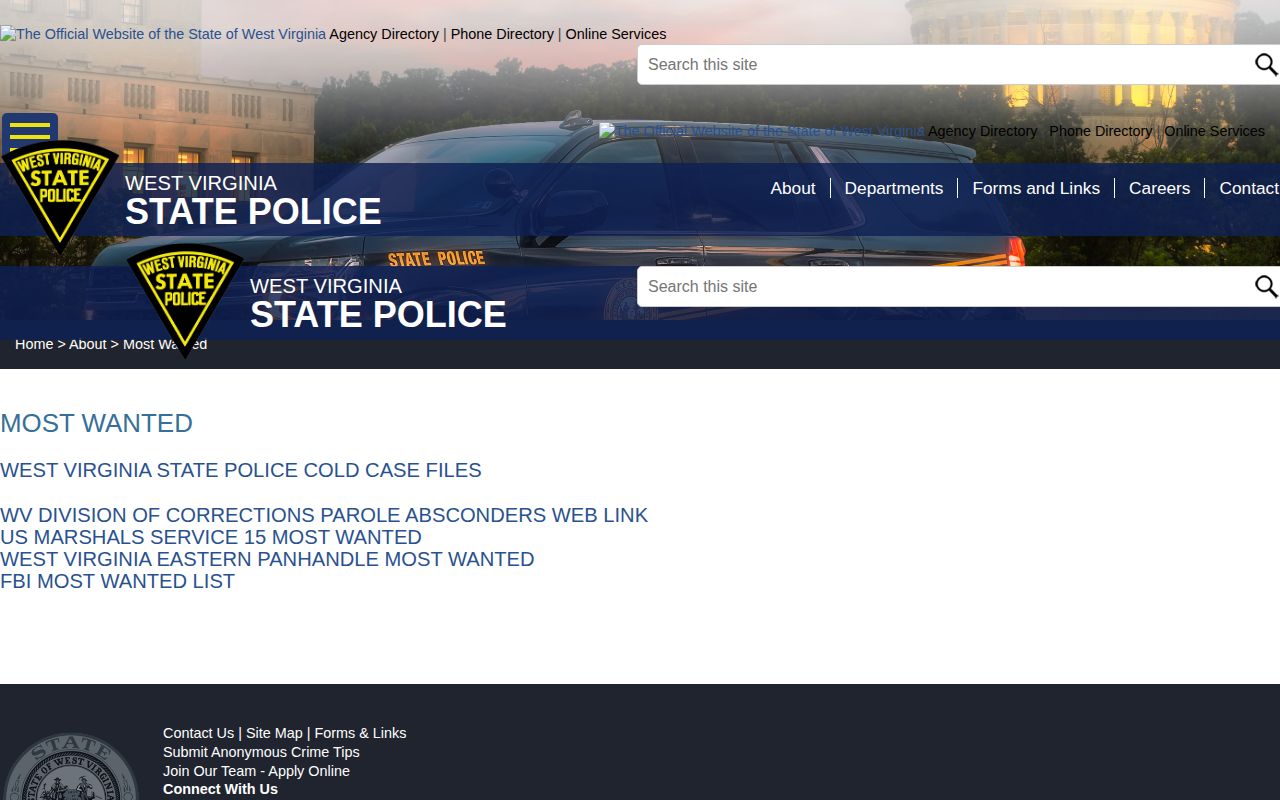
Handle one record at a time. That habit matters here. A State Police notice might involve a statewide matter or a partner agency, while a Cabell court entry could trace back to a separate circuit or lower-court case. Shared wording between two sources proves nothing. Before treating them as one matter, compare the agency, the court, the case number, the county, and a date of birth where law allows. If even one detail does not line up, name matching is not enough. Ask the clerk or the issuing agency directly.
Statewide directories add useful context. They cannot replace confirmation straight from a Cabell court or the agency that issued the paper. For a tip, a correction, or a current status question, the original publisher is still the right door to knock on.
Check Cabell County Warrants
Checking Cabell County warrants is a records-and-court task. There is no one-stop search box. Start with the official West Virginia Magistrate Case Search. Enter a first and last name or a case number. The results can include the filing date, the charge, the disposition, and any listed documents, which may leave a clear case trail. Still, the search has limits. It cannot confirm on its own whether a warrant is active, served, recalled, sealed, or changed in some other way. For that answer, contact the court or the agency that holds the file.
- Start with the exact legal name and, when available, date of birth, case number, and issuing county. Similar names need more than a name-only match.
- Search Magistrate Case Search for a lower-court case. For a Cabell Magistrate question, call the clerk at 304-526-8642 or 304-526-8644 and ask what record or status can be confirmed.
- For a felony or circuit matter, search WV PASS and contact Cabell Circuit Clerk Michael J. Woelfel at 304-526-8622. Public circuit files have access limits, and an unavailable result does not settle the question.
- Route a sheriff-created warrant, deputy service record, or sheriff-held record to Cabell County Sheriff Douglas W. Adams at 304-526-8663. For a Huntington municipal matter, use the issuing court or Huntington Municipal Court at 304-696-5920.
The Magistrate Case Search interface is the right place to begin a lower-court record. The image shows the source interface itself, not a result for any named person. Save your query details. When something looks unclear, let the clerk sort it out rather than reading a screen result as a live warrant confirmation.
id
paragraphs
Keep custody and court status separate. A person may show a booking record, a bond decision, a later filing, or no custody entry at all. Each source answers a different question.
Keep custody and court status separate. A person may show a booking record, a bond decision, a later filing, or no custody entry at all. Each source answers a different question.
Cabell Warrant Types
Cabell County splits its court work between two levels. Magistrates handle misdemeanors, felony preliminary examinations, warrants, and bail or bond questions. Felony cases and other general-jurisdiction matters move up to circuit court. That happens once the lower-court stage ends. The label on a warrant describes the court process behind it. It says nothing about a person's standing. Where you look depends on which court and agency handled the matter.
| Process label | Official Cabell route | What to verify |
|---|---|---|
| Bench warrant | Magistrate Case Search and Magistrate Clerk | Case number, court action, and current clerk-confirmed status. |
| Arrest warrant | Issuing magistrate, court, or agency | Issuing court, name match, and whether the process remains active. |
| Felony matter | WV PASS and Cabell Circuit Clerk | Public circuit case history and later court action. |
| City process | Issuing court or department | Municipal case details, including the Huntington court route when applicable. |
A few terms carry weight here. A warrant is authorization issued by a court. A bond is a condition the court sets for release while a case moves forward. A disposition is the outcome a court records later. That could be a dismissal, a plea, or another action. Knowing the sequence helps. You can read a booking or notice for what it actually says.
Note: When an online result is missing or unclear, a clerk or the issuing agency is the only dependable way to resolve a current-status question.
Cabell Wanted Tips and Safety
Think you've spotted a wanted person? Go through an official channel rather than making contact yourself. Huntington Police runs an anonymous tip line at 304-696-4444 that gets checked daily, and its Criminal Investigations Division sits at 304-696-4420. Milton Police lists 304-505-TIPS, or 8477. Federal fugitive tips can go to the U.S. Marshals Service wanted line at 1-877-WANTED-2, and the Southern District of West Virginia keeps a Huntington office at 304-529-5560. That federal presence is a task force, though, not a public warrant roster for the county.
Safety notice. Never approach, confront, follow, or detain anyone based on a wanted notice or an online record, and never try to serve process yourself. Call 911 if there's an immediate threat. Otherwise, hand what you know to the agency in charge.
No Cabell-specific Crime Stoppers program turned up anywhere. No anonymous-reward policy either. No local reward amount. The numbers listed above do accept information. But a tip route offers no promise of payment. It also gives no confirmation that anyone is actually wanted. Share the original agency notice and the location. Give only the facts you personally know.
Cabell Warrant Results Have Limits
Cabell has no verified public all-warrant database. That gap shapes everything else. A practical official check means combining Magistrate Case Search, WV PASS, the Cabell clerks, and the sheriff or the issuing police agency. The statewide State Police hub helps only as a clearly labeled side resource, never as a Cabell roster.
Even a precise query can come up empty. Sealed material, a juvenile matter, a common-name mismatch, a delayed entry, a different issuing county, or plain access restrictions can all hide a result. A court record may also show a filing while saying nothing about whether it has been served. Follow the clerk's guidance and use the original case number when the stakes are legal.
If a warrant or notice might concern you, talk to an attorney or the issuing court and address it safely. Never lean on a public record to dodge court process.
Keep the search tight and factual. Exact spelling, date of birth, case number, and issuing county all cut the risk of mixing one person's case with someone else's record. Missing those details? The clerk or counsel can point you to the proper next record request.